
Brussels, Belgium
What to Do in Brussels in 4 Days: Grand-Place, Chocolate, and the Art Nouveau Streets
A picture-first walk through the guild houses, the surreal art, and the neighbourhoods where Brussels stops being a stopover.
TL;DR
Brussels rewards the traveler who slows down: gilded squares at golden hour, Magritte's floating apples, and chocolate you actually learn to temper.
- Grand-Place at dusk, when the gold leaf catches the last light
- Magritte Museum, three floors of pipes that are not pipes
- Horta's stairwell, where iron curls like a vine toward the skylight
- The Atomium's steel spheres, bigger and stranger up close
- Sunday morning flea market chaos at Place du Jeu de Balle
- A chocolate workshop where you leave with your own filled pralines
Have this trip planned in 60 seconds
We built the Brussels, Belgium itinerary that pairs with this guide, day-by-day with verified venues and one-tap booking links. Free to adopt, edit however you want.
The Ride In, Before the City Reveals Itself
Flat fields and canals slide past the train window, then the city thickens into brick and the smell of diesel and rain.

Brussels Airport sits about 12 km northeast of the centre, and the easiest first move is the train from the airport station straight to Bruxelles-Central. It runs every 15 minutes or so and takes roughly 20 minutes; a single ticket is around 12 EUR (about 13 USD), with a small airport surcharge baked in. Check current times on the SNCB site before you go: https://www.belgiantrain.be/en.
If you land tired with a suitcase that refuses to roll straight, a pre-booked transfer is worth the extra euros. You skip the ticket machines, and the driver drops you at your hotel door instead of a busy central platform.
Either way, aim to arrive in the late afternoon. That gives you just enough time to drop your bags and walk toward the Grand-Place while the light is still soft.
Grand-Place at the Hour the Gold Turns On
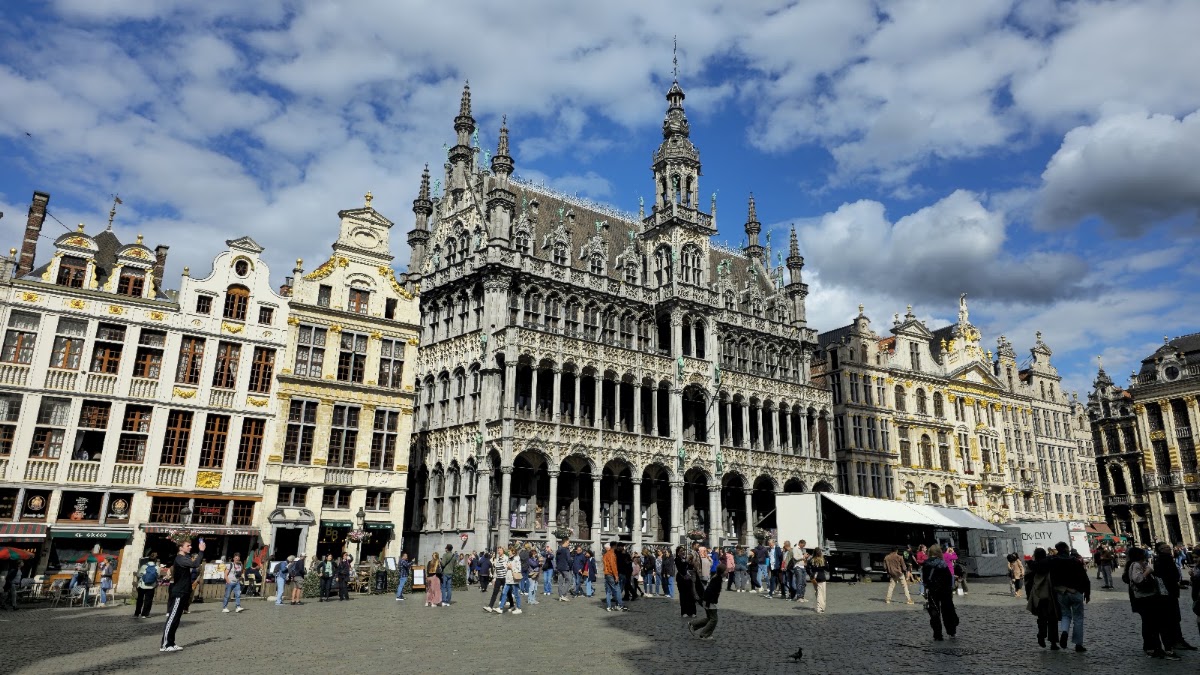
You turn a narrow corner off Rue de la Colline and the square opens all at once, guild houses stacked with gilded scrollwork glowing like they are lit from inside.

This is the moment Brussels stops being a name on a map. The Grand-Place is a rectangle of 17th-century guild houses and the spiky Gothic tower of the Town Hall, and at dusk the low sun sets the gold leaf on every facade alight. Look up at the House of the Dukes of Brabant, then find the swan carved above the old butchers' guild.
Go early evening on your first day, then again after dark, when the buildings are floodlit and the crowds thin. The square is UNESCO-listed, and you can read the backstory on the UNESCO page: https://whc.unesco.org/en/list/857.
Grab a Belgian beer at one of the cafes lining the edge, sit on the cobbles if there is room, and just watch the light change. This is your orientation point for the whole trip; nearly everything else radiates out from here.
The Palace That Only Opens When the King Is Away
White stone, tall windows, and a long forecourt where the guards' boots click on the pavement in the morning quiet.

Start day two at the Royal Palace of Brussels, the official ceremonial home of the Belgian monarch. Here is the quirk: the king does not actually live here (he uses the Castle of Laeken), and the palace only opens to visitors for a few weeks in summer, usually late July through early September. Check the official schedule before you build your day around it: https://www.monarchie.be.
If you catch the open season, the Mirror Room is the payoff. Its ceiling is covered in the wing cases of Thai jewel beetles, shimmering green, an art installation you have to see moving to believe.
Outside opening season, the exterior and the leafy Parc de Bruxelles across the road still make a fine slow morning. Sit on a bench, watch the fountains, then walk two minutes uphill toward the museums.
Three Floors of Pipes That Are Not Pipes
A bowler hat floats where a face should be, an apple fills a room, and a train steams out of a fireplace. You lean in, then step back, then laugh.
The Magritte Museum holds the largest collection of Rene Magritte's work anywhere, and it is a short walk from the palace on Place Royale. The building takes you chronologically through his life, from early advertising work to the surreal paintings that made him famous. Standard entry is around 12 EUR (about 13 USD); see current hours on the museum site: https://www.musee-magritte-museum.be.
What surprises most people is how playful it feels in person. The famous "Ceci n'est pas une pipe" hits differently when the actual canvas is in front of you and you realise the joke is on your own certainty.
Give it about 90 minutes. The upper floors get quieter, and there is a small cafe if you need a coffee before lunch.
The House Where Iron Grows Like a Vine
You climb a staircase and the banister curls, the light pours down through a stained-glass ceiling, and every line in the building seems to breathe.
After a long brasserie lunch (order the stoemp or a proper vol-au-vent and a glass of Trappist beer), head to the Horta Museum in the Saint-Gilles district. This was the home and studio of Victor Horta, the architect who basically invented Art Nouveau, and the whole house is a UNESCO site: https://whc.unesco.org/en/list/1005.
The stairwell is the star. Wrought iron twists into plant forms, mosaic floors ripple underfoot, and daylight filters through amber glass overhead. Photography is not allowed inside, which is oddly freeing; you just look.
It is a 15-minute tram ride from the centre, so it pairs well with a wander through the surrounding streets, where more Horta-designed facades hide in plain sight. Entry is around 12 EUR (about 13 USD).
Dinner Where the Old Fish Market Used to Be
Strings of lights over a former harbour basin, the clatter of mussel pots, and the smell of butter and white wine drifting out of open doors.
Finish day two in Sainte-Catherine, the neighbourhood built around a filled-in port. It has long been the place Brussels comes to eat seafood, and the restaurants around the old church still serve moules-frites the way you hope they will: a steaming black pot, a mound of fries, a cold beer.
The area feels more local than the tourist strip near the Grand-Place. Wander the Quai aux Briques, read a few menus, and pick the place that smells best rather than the one with the loudest waiter out front.
Budget around 25 to 35 EUR (about 27 to 38 USD) for a mussels dinner with a drink. Book ahead on weekends; the good spots fill up fast.
Nine Steel Spheres, Bigger Than the Photos
It gleams against the sky, all mirrored curves and tubes, and only when you stand beneath it do you feel how absurdly large a model atom can be.

Day three goes big. The Atomium was built for the 1958 World's Fair and shaped like an iron crystal magnified 165 billion times. You can ride the escalators and lift up through the connecting tubes into the spheres, some of which hold exhibitions and a panoramic viewpoint over the city. Tickets run around 16 EUR (about 17 USD); details at https://atomium.be.
It sits in the Heysel area north of the centre, an easy metro ride on line 6 to Heysel station. Go in the morning to beat the tour groups, and give yourself time for the top sphere, where the view stretches across northern Brussels.
If you have kids or a design streak, the nearby Mini-Europe park makes an easy add-on. Otherwise, head back into town for the afternoon.
Tempering Chocolate With Your Own Hands
Warm cocoa hangs in the air, a marble slab cools under your palm, and your first shaky praline turns out better than it has any right to.
You cannot leave Belgium without doing chocolate properly, and a workshop beats another shop window. At Choco Story Brussels, near the Grand-Place, you can join a hands-on session where a chocolatier walks you through tempering, moulding, and filling your own pralines, then you eat and box up what you make. Check times and book at https://choco-story-brussels.be.
Before or after, the museum side explains how cacao travelled from Mesoamerica to Brussels and why Belgian chocolate earned its reputation. It is more interesting than it sounds once you are holding a warm mould.
Spend the free evening drifting through the Marolles district and its Place du Jeu de Balle. If you time your last morning for a Sunday, the flea market there sprawls across the square from dawn: old cameras, chipped porcelain, and vendors who will haggle over coffee. Grab breakfast at a traditional bakery nearby, a warm croissant and a strong coffee, before your train back to the airport.
Ready to book?
Book the rest of Brussels, Belgium
Handpicked partner searches, dates pre-filled. Pricing is identical to going direct — the partner shares a small commission with Tabi so this guide stays free.
Frequently asked
How many days do you really need in Brussels?
Four days is the sweet spot. Two gives you the Grand-Place, one museum, and a good dinner. Four lets you add the Atomium, an Art Nouveau house like the Horta Museum, a chocolate workshop, and an unhurried morning in the Marolles flea market without feeling like you are sprinting.
Is the Royal Palace always open to visitors?
No. The Royal Palace of Brussels only opens to the public for a few weeks each summer, typically late July into early September, when the king is not in official residence. Check the monarchy's website before you plan a visit around it, and enjoy the exterior and Parc de Bruxelles the rest of the year.
What's the easiest way to get from Brussels Airport to the city centre?
The train from the airport station to Bruxelles-Central takes about 20 minutes and costs roughly 12 EUR including the airport surcharge. It runs every 15 minutes or so. If you are arriving late or with heavy luggage, a pre-booked private transfer drops you straight at your hotel.
Do I need to book museum tickets in advance?
For the Magritte Museum and the Horta Museum, buying online saves queue time, especially on weekends and in summer. The Horta Museum in particular limits numbers inside, so slots can sell out. Chocolate workshops almost always need booking ahead because group sizes are small.
When is the Place du Jeu de Balle flea market on?
The flea market in the Marolles runs every morning of the week, but it is biggest and best on Saturdays and Sundays, when it fills the whole square from early morning until around 2pm. Come early for the good finds and the calmer light for photos.
Skip the planning
Your Brussels, Belgium trip, ready to go
Adopt the day-by-day itinerary we built to match this guide. Every stop is a real place, every booking link is validated. Free forever, no card needed.
Open the Brussels, Belgium itinerary