
Krakow, Poland
What to Do in Krakow in 4 Days: Squares, Kazimierz, and the Walk Through History
A picture-first walk through Krakow, from the bugle call over the Main Market Square to the quiet weight of Auschwitz and back.
TL;DR
Krakow packs a whole medieval kingdom, a soulful Jewish quarter, and one of history's heaviest sites into a walkable four days you'll keep replaying.
- Trumpet call breaks off mid-note over Rynek Główny, Europe's biggest medieval square
- Pierogi and beet soup at a milk bar for under 30 zloty
- Kazimierz backstreets, candlelit cafes, and the click of vintage doorways
- The silent walk beneath the gate at Auschwitz-Birkenau
- Wawel Cathedral bells and the dragon that breathes real fire by the river
Have this trip planned in 60 seconds
We built the Krakow, Poland itinerary that pairs with this guide, day-by-day with verified venues and one-tap booking links. Free to adopt, edit however you want.
Landing at KRK and the First Glimpse of the Old Town
The taxi rounds the Planty park ring, the medieval walls slide past your window, and suddenly the modern city just stops.
Krakow Airport (KRK) sits about 11 km west of the center, and the drive in takes roughly 25 minutes outside rush hour. There's an airport train too (the SKA line into Kraków Główny, around 17 zloty, about 8 USD), but after a flight it's hard to beat a car that drops you at your door.
Book a transfer ahead so you're not haggling curbside at midnight. Watch the moment the road slips inside the Planty, the leafy green ring that traces where the old city walls once stood. Everything inside it is walkable, which is the whole trick to Krakow: you almost never need wheels again until you leave.
Drop your bag, then walk five minutes toward the sound of church bells. That's your compass for the next four days.
The Trumpet Call That Stops Mid-Note
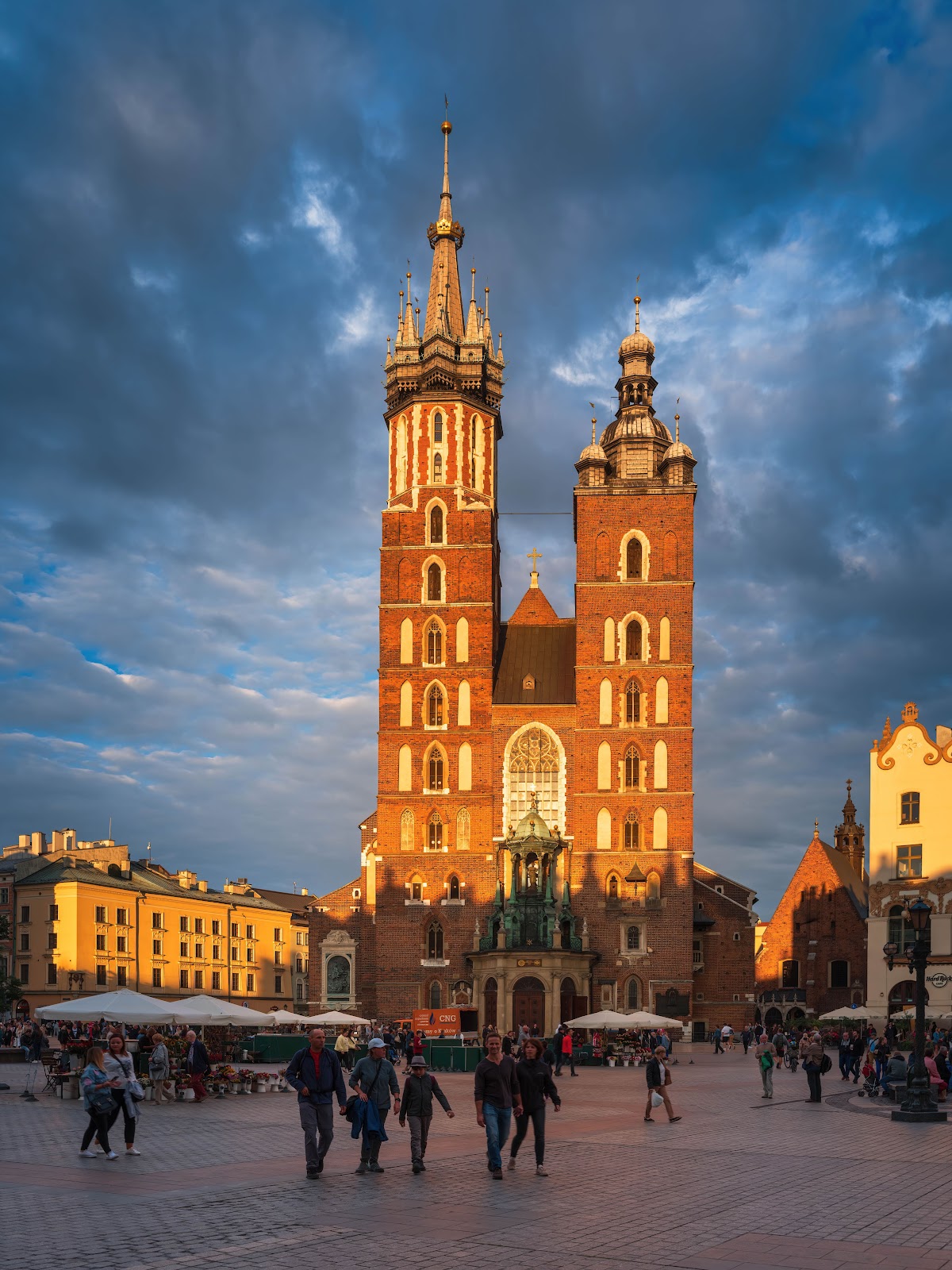
Every hour, a lone trumpeter leans out of St. Mary's tower, plays the hejnał, and cuts off abruptly, the exact note where a 13th-century watchman was said to take an arrow to the throat.
Rynek Główny is the largest medieval town square in Europe, a vast expanse of pigeons, flower stalls, horse-drawn carriages, and cafe tables that spill out until well past dark. Stand in the middle and turn a slow circle. St. Mary's Basilica with its two mismatched towers, the long arcaded Cloth Hall (Sukiennice) running down the center, the small copper-domed church of St. Adalbert that predates almost everything around it.
A guided walk here is worth it for the stories you'd never guess: the legend behind the broken trumpet call, the two brothers who supposedly built the towers, the underground market rooms now open as a museum beneath your feet.
Duck into the Cloth Hall to browse amber and carved wood, then grab an outdoor table and just watch the square work. Coffee runs about 15-20 zloty (4-5 USD). This is the room you'll picture when you think of Krakow later.
Pierogi at a Milk Bar, the Way Locals Actually Eat
You point at what looks good behind steamed-up glass, a stern woman ladles it onto a chipped plate, and you walk away with lunch for the price of a coffee back home.
A bar mleczny (milk bar) is a Polish institution that survived from the communist era: no-frills canteens serving hearty homemade food at prices that feel like a printing error. Think pierogi (dumplings) stuffed with potato and cheese or minced meat, żurek (sour rye soup served in a bread bowl), barszcz (that deep-magenta beet soup), and golden potato pancakes.
A full plate of pierogi with soup often lands under 30 zloty (about 8 USD). The system is old-school: read the wall menu, order and pay at the counter, wait for your number or your name barked out, bus your own tray.
Don't expect English or decor. Do expect the kind of dumplings someone's grandmother would approve of. It's the most honest meal you'll eat all trip.
Kazimierz After Dark: Candlelight and Vintage Doorways
The cobbles turn uneven, the streetlights go amber, and every second doorway opens into a cramped bar full of mismatched armchairs and someone playing klezmer in the corner.
Kazimierz was Krakow's Jewish quarter for centuries, and today it's the city's most atmospheric neighborhood: a layered mix of old synagogues, art galleries, secondhand shops, and some of the best bars and cafes in Poland. By day, wander Szeroka Street and the plac Nowy market with its famous zapiekanka stalls (open-faced toasted baguettes loaded with mushrooms and cheese, a few zloty each).
Walk past the Old Synagogue and the tiny Remuh cemetery, then let yourself get lost. The whole quarter is compact enough that getting lost just means finding another courtyard.
Come back after dark. The candlelit interiors, the peeling vintage walls, the live music drifting out of open windows: this is where Krakow feels most itself. Give yourself a free evening here with no plan.
The Silence Under the Gate at Auschwitz-Birkenau
The bus goes quiet on its own about ten minutes out. Then the gate appears, the words above it, the railway line running straight into the middle of the camp.
Auschwitz-Birkenau sits in Oświęcim, about 70 km west of Krakow, roughly a 90-minute drive. It's the most important thing many travelers do in Poland, and it should be approached that way: not as a sight, but as a place to bear witness.
Entry to the memorial is free, but between roughly 10:00 and 15:00 you must join a guided educational tour, and slots book out days or weeks ahead. Going with an organized bus from Krakow handles the reservation, the transport, and a guide who carries you through both the Auschwitz I barracks and the vast Birkenau site with the care it demands. See the official museum site (auschwitz.org) for current rules and dress guidance.
Bring water, wear comfortable shoes, and expect several hours of walking. There's no easy way to describe the return drive. You'll mostly ride in silence, and that's exactly right.
Schindler's Factory and the Krakow of 1939
You step from a normal Podgórze street into a recreated 1930s tram, and the walls close in as the city tips from ordinary life into occupation.
Oskar Schindler's former enamelware factory is now one of Krakow's most gripping museums, but it's not really about Schindler. It's a full, immersive telling of Krakow under Nazi occupation from 1939 to 1945, built room by room: a hairdresser's shop, a cramped ghetto apartment, propaganda posters layered on the walls, personal testimonies playing on loop.
Tickets run around 32 zloty (about 8 USD) and sell out, so book a timed slot online in advance. Give yourself at least two hours; the layout is a one-way path and it does not rush you.
Afterward, walk a few minutes to Plac Bohaterów Getta, the square of the empty chairs, a memorial where 70 oversized bronze chairs stand for the belongings left behind during the ghetto deportations. It's quietly devastating and easy to miss.
Wawel Castle, the Cathedral Bells, and a Dragon by the River
The hill rises straight out of the Vistula, the cathedral's copper domes catch the light, and down at the water's edge a bronze dragon breathes an actual jet of fire.
Wawel Royal Castle was the seat of Polish kings for 500 years, and the complex sprawls across a low hill above the river: the arcaded Renaissance courtyard, the treasury and armory, the state rooms hung with tapestries, and the extraordinary Wawel Cathedral where Polish monarchs were crowned and buried.
The grounds are free to walk, but each attraction (castle rooms, cathedral, the Sigismund Bell tower, the dragon's den cave) is a separate timed ticket, usually 20-40 zloty each. Climb the narrow wooden stairs to touch the giant Sigismund Bell for luck if the queue isn't brutal.
Then head down the far side to the riverbank, where the Wawel Dragon statue puffs fire every few minutes to the delight of every child within fifty meters. For a last Krakow lunch, backtrack toward the Old Town: the streets between Wawel and the square are full of restaurants doing proper Polish plates. A hearty sit-down meal runs about 60-90 zloty (15-23 USD).
Last Breakfast and the Ride Back to KRK
One more plate of scrambled eggs and dark rye bread, the bells starting up somewhere across the rooftops, and then it's time to trace the Planty ring back out.
Krakow makes for a gentle exit. Have a slow hotel breakfast, then if the flight allows, take a final loop of the Planty or grab one last coffee on the square while the flower sellers set up.
The airport is close, so a transfer only needs 25-30 minutes of driving time, but pad it for morning traffic. If you'd rather go by rail, the SKA train from Kraków Główny runs every half hour and takes under 20 minutes.
Four days is enough to feel Krakow's whole range: the medieval swagger of the square, the soul of Kazimierz, the unflinching history to the west, the royal weight of Wawel. Most people leave already planning the next visit.
Ready to book?
Book the rest of Krakow, Poland
Handpicked partner searches, dates pre-filled. Pricing is identical to going direct — the partner shares a small commission with Tabi so this guide stays free.
Frequently asked
How many days do you need in Krakow?
Four days is the sweet spot. You get two relaxed days for the Old Town, Wawel, and Kazimierz, a full day for Auschwitz-Birkenau, and time for Schindler's Factory, without ever feeling rushed. Three days is doable if you're efficient, but Auschwitz eats most of one day on its own.
Do I need to book Auschwitz-Birkenau in advance?
Yes. Entry is free but a guided educational tour is mandatory between roughly 10:00 and 15:00, and slots sell out days to weeks ahead. The simplest option is an organized bus tour from Krakow, which bundles the reservation, the 90-minute transport each way, and a guide. Check auschwitz.org for current rules.
Is Krakow walkable, or do I need public transport?
Almost entirely walkable. The Old Town, Wawel Castle, and the Kazimierz quarter sit within a 20-minute walk of each other, all inside the Planty park ring. You'll only need transport for the airport and the day trip to Auschwitz. Trams and buses are cheap and easy if you're staying farther out.
What should I eat in Krakow?
Start with pierogi (dumplings), żurek (sour rye soup in a bread bowl), and barszcz (beet soup), ideally at a bar mleczny (milk bar) where a full meal runs under 30 zloty. In Kazimierz, grab a zapiekanka toasted baguette from the plac Nowy stalls. Wash it all down with local craft beer or a shot of Polish vodka.
How do I get from Krakow Airport to the city center?
It's about 11 km. The SKA train from the airport to Kraków Główny takes under 20 minutes and runs every half hour for around 17 zloty (8 USD). A private transfer or taxi takes 25-30 minutes and drops you at your door, which is worth it with luggage or after a late flight.
Skip the planning
Your Krakow, Poland trip, ready to go
Adopt the day-by-day itinerary we built to match this guide. Every stop is a real place, every booking link is validated. Free forever, no card needed.
Open the Krakow, Poland itinerary