
Marrakech, Morocco
Marrakech in 5 Days: Palaces, Souks, and the Atlas Escape
Mint tea on a medina rooftop, tagine smoke in the Jemaa el-Fnaa night, and a hike into the High Atlas, this is Marrakech at its most alive.
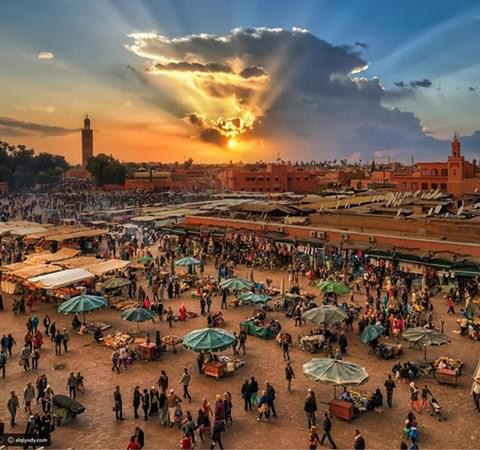
TL;DR
Spend your days wandering the souk alleys, your evenings on a rooftop overlooking Jemaa el-Fnaa, and one day escaping to the Atlas Mountains, here's where to go, eat, and sleep.
- Koutoubia Mosque's minaret rising above the palm gardens at golden hour
- Rooftop mint tea over the Jemaa el-Fnaa plaza as the call to prayer echoes
- Bahia Palace's mosaic courtyards and painted cedar ceilings
- The souk sellers at Souk Semmarine bargaining over leather and brass
- Berber tagine lunch in an Imlil village home with Atlas peaks as the backdrop
Have this trip planned in 60 seconds
We built the Marrakech, Morocco itinerary that pairs with this guide, day-by-day with verified venues and one-tap booking links. Free to adopt, edit however you want.
The Riad Courtyard: A Quiet Oasis
Step through a heavy wooden door off a narrow alley, and suddenly you're in a courtyard with orange trees, a gurgling fountain, and five teacups waiting on a brass tray.
Your first taste of Marrakech is this: cool mint tea sipped on a beaten-silver table, the faint smell of rosewater in the air. The riad's tiles are a mosaic of zellij in blues and greens, each pattern a repetition begun 400 years ago.
From the rooftop terrace you'll hear the first calls to prayer drift across the medina, a mix of muezzins overlapping, one from the Koutoubia minaret, another from a smaller neighborhood mosque. This is your home base for the next five days.
Koutoubia Mosque: The Minaret and the Gardens
The minaret rises 77 meters above the palm grove, its stone glowing rosy in the late afternoon light, and the scent of fresh jasmine drifts from the gardens below.
Koutoubia Mosque is the largest in Marrakech, but you won't enter, non-Muslims can't. Instead, walk the sprawling rose gardens that wrap around it. The fragrance hits you first: dozens of rose varieties planted in neat rows, watered by channels that have run for centuries.
Pause at the north side for the classic view: the minaret with the Atlas snowcaps in the distance. Locals read on benches here, and the call to prayer at sunset is a spine-tingling moment.
Jemaa el-Fnaa Night Market: Smoke and Sizzle
By sundown, the plaza transforms: charcoal grills smoke, drums beat, and the air thickens with the smell of grilled merguez and lamb brochettes.
Jemaa el-Fnaa is a sensory overload in the best way. You'll walk past snake charmers and orange juice stalls before reaching the food section. Grab a stool at Stall 14 (the numbers are on the canopies) for a bowl of heri, a slow-cooked lamb and lentil soup, or snails in broth.
Don't leave without trying the fried cuttlefish and a hot mint tea. The chaos is part of the charm; just eat where the crowd is thickest. For a rooftop view, look for Cafe France or any terrace facing the square.
Saadian Tombs and the Mellah: History in Two Steps
Marble tombs in a quiet garden where no one speaks above a whisper; then, around the corner, the bustling lanes of the old Jewish Quarter with silver shops and spice-sellers.
The Saadian Tombs were sealed for 400 years until their rediscovery in 1917. You'll duck through a narrow passage into a courtyard where twelve intricately carved tombs sit under a tiled roof. The green and gold mihrab catches the light. Keep your voice low, the respect is palpable.
Walk five minutes south to the Mellah. The Jewish Quarter's main street smells of fresh bread and cinnamon. Stop at Azama Bakery for a sesame-bread ring (kaab el ghazal) still warm from the oven.
Bahia and El Badi: Two Palaces, Two Moods
Bahia's stucco and zellij mosaics feel like a living palace; El Badi's ruins are a skeleton of ambition, with storks nesting on the ramparts.
Bahia Palace is all about detail: hand-carved cedar ceilings, marble columns, and a grand courtyard planted with orange and jasmine. Walk room to room, each one opens onto a different garden patio. The 160-room complex was built for a 19th-century grand vizier, but you'll only see a fraction.
Across the street, El Badi Palace is ruin-porn at its best. The vast sunken gardens and reflecting pools are empty now, but you can climb the ramparts for a panoramic view over the medina. Storks clatter their beaks from nests on the walls.
Ben Youssef Madrasa and the Souk Maze
Carved cedar and marble in the madrasa's courtyard, then the sudden plunge into the covered alleys of Souk Semmarine where brass lanterns dangle and spices pile high.
Ben Youssef Madrasa was once the largest Islamic college in North Africa. The courtyard hits you with its symmetry: a central pool reflecting the arches and the intricate zellij tilework. Climb to the student dormitory rooms for a view of the entire complex.
Step outside and the souk swallows you. Souk Semmarine is the main artery for leather, babouches, and scarves. Turn right into Souk El Attarine for the head-spinning scent of saffron, cumin, and dried rose petals. Prices are for haggling: offer half, settle at two-thirds.
Jardin Majorelle: Electric Blue Among the Cacti
The shocking blue of the villa against a forest of giant cacti and bamboo groves, it's a color you don't forget, and neither does the garden.
Jardin Majorelle was designed by French painter Jacques Majorelle, and later restored by Yves Saint Laurent. The main villa is painted in a shade of blue that seems to absorb the sunlight. Walk the winding paths past bamboos, agaves, and a water lily pond with turtles.
Next door, the Berber Museum inside the villa displays YSL's private collection of Berber jewelry, costumes, and carpets. The gift shop sells reproductions of his sketches. Try to go early (8:30 AM) to avoid the crowds that fill the garden by 10.
High Atlas Day: Imlil Village and Berber Tagine
The road from Asni winds past walnut groves and rushing rivers; then you're in a stone house watching a Berber woman cook tagine over an open fire.
Leave the medina behind for a day. Drive an hour south through Asni, where the Monday market is a swirl of carpets and goats, then climb into the High Atlas. Imlil is a small village at 1,800 meters. Your guide will walk you through terraced fields and apple orchards before stopping at a home for lunch.
The tagine is cooked in a clay pot over coals, chicken with preserved lemon and olives, or lamb with prunes. You sit cross-legged on cushions, eating with bread. Afterward, walk to a viewpoint to see Jebel Toubkal, North Africa's highest peak (4,167 m).
Ready to book?
Book the rest of Marrakech, Morocco
Handpicked partner searches, dates pre-filled. Pricing is identical to going direct — the partner shares a small commission with Tabi so this guide stays free.
Frequently asked
How many days do you need in Marrakech?
Five days is the sweet spot: three full days in the medina and one day trip to the High Atlas or Ourika Valley. A shorter 3-day trip works if you skip the Atlas and focus on the palaces and souks.
Is it safe to walk around the medina at night?
Yes, the medina is generally safe, but stick to the main lit alleys after dark. Jemaa el-Fnaa is busy and well-patrolled until late. Use a riad's directions or a guide to avoid unlit dead ends.
What should I wear in Marrakech?
Cover shoulders and knees to respect local culture, especially near mosques and in the medina. Light linen clothing works year-round (summer is hot). Bring a scarf for entering religious sites and a light jacket for cool evenings.
Do I need to bargain in the souks?
Yes, bargaining is expected. Start at half the asking price and meet somewhere around 60-70% of the initial quote. If a seller says a price and you walk away, they'll often call you back with a lower one.
Skip the planning
Your Marrakech, Morocco trip, ready to go
Adopt the day-by-day itinerary we built to match this guide. Every stop is a real place, every booking link is validated. Free forever, no card needed.
Open the Marrakech, Morocco itinerary