
Nairobi, Kenya
What to Do in Nairobi: Lions at Dawn, Baby Elephants, and a City That Surprises You
A 4-day walking-and-driving log through the only capital on earth with a national park in its backyard.
TL;DR
Nairobi is the rare city where you can watch a lion stretch at sunrise and be back for a flat white by 10am, so lean into that contradiction.
- Sunrise game drive in Nairobi National Park, skyline behind the lions
- Orphaned baby elephants kicking mud at Sheldrick Wildlife Trust
- A giraffe's purple tongue reaching for your palm in Langata
- Karen Blixen's farmhouse under the Ngong Hills, coffee garden next door
- Sizzling nyama choma and the whole-city view from the KICC rooftop
Have this trip planned in 60 seconds
We built the Nairobi, Kenya itinerary that pairs with this guide, day-by-day with verified venues and one-tap booking links. Free to adopt, edit however you want.
Touchdown, and the First Whiff of Wood Smoke
You step out of Jomo Kenyatta International and the air is thin, cool, faintly sweet with acacia and diesel. Nairobi sits at 1,795m, so the light is sharp and the evenings need a jacket.
The airport is about 15km southeast of the city center, but Nairobi traffic has a mind of its own, so budget 45 minutes to well over an hour depending on when you land. A pre-booked driver waiting with your name saves you the taxi-rank negotiation after a long flight.
Drop your bags, splash your face, then go straight into the deep end: dinner at Carnivore in Langata. It has been grilling meat over a huge central pit since the 1980s, and yes, it is touristy, and yes, you should still go on night one. Skewers of everything keep arriving at your table on Maasai swords until you lower the little paper flag to surrender. Ask what is on the exotic-meat rotation that evening; crocodile and ostrich turn up more often than you would think.
Ease in, sleep it off. The wildlife starts early tomorrow.
Lions Before Breakfast, Skyline Behind Them
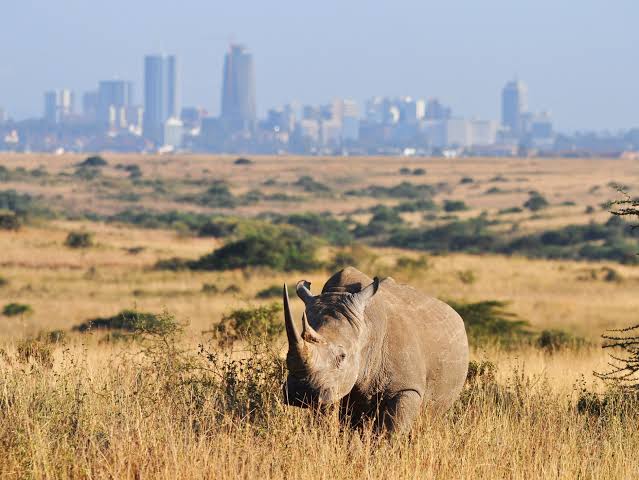
A rhino grazes in tall gold grass, and rising directly behind it are office towers. This is the only place on the planet where that photo is possible.
Nairobi National Park sits right against the southern edge of the city, no long transfer required, which is why you start here at dawn while the animals are still moving and the light is soft. Lion, buffalo, giraffe, zebra, and black rhino all roam inside the fence; the only open side runs south toward the Athi plains, so the wildlife comes and goes on ancient migration lines.
Go with a proper 4x4 and a guide who knows the morning waterholes. The park entry for non-residents runs around USD 43 (roughly KES 5,700), separate from your vehicle and guide. See the Kenya Wildlife Service park page for current rates and gate times: https://www.kws.go.ke/parks/nairobi-national-park
Keep the camera ready on the drive out too. Ostriches like to sprint alongside the track, and the skyline-plus-savanna shot usually lands on the way back to the gate.
The 11 O'Clock Mud Bath at Sheldrick
A dozen orphaned elephants come thundering down a red-dirt slope, ears flapping, and go straight for the milk bottles and a puddle they treat like the best thing that ever happened.
The David Sheldrick Wildlife Trust rescues elephants (and the occasional rhino) orphaned by poaching or drought, hand-rears them, and eventually returns them to the wild in Tsavo. The public viewing is a single hour, usually from 11am to noon, and it is one of the most genuinely moving 60 minutes you will spend in Kenya.
Booking ahead is essential; visits are timed and capacity is limited. Reserve your slot and check the daily details on the Trust site: https://www.sheldrickwildlifetrust.org/visit
The keepers narrate as the babies feed, explaining each one's story, why it arrived, how it is doing. A small entry donation goes straight back into the orphanage, and you can foster an elephant on the spot if one of them steals your heart, which one of them absolutely will.
A Giraffe's Tongue on Your Palm
You hold out a food pellet and a Rothschild's giraffe leans in from the raised platform, wraps a long purple-grey tongue around your hand, and looks at you with lashes a mascara ad would envy.
The Giraffe Centre in Langata was set up to breed the endangered Rothschild's giraffe, and the raised feeding deck puts you exactly at head height with these enormous, gentle animals. Entry for non-resident adults is around KES 1,500 (about USD 12), and the warthogs snuffling below the platform come free with the ticket.
It is a short hop from here to the Karen neighborhood, so this pairs naturally with your afternoon. The staff are relentlessly patient with the science: ask why the Rothschild's has no markings below the knee, or how they tell individuals apart, and you will get a proper answer.
A quick tip: keep pellets in a closed hand until you are ready. These are opportunists with very long necks.
Karen Blixen's Farmhouse Under the Ngong Hills
Cool stone floors, a coffee-drying yard gone quiet, and through the windows the low green line of the Ngong Hills that opens Out of Africa.
This was the farmhouse of Danish writer Karen Blixen, who ran a coffee plantation here from 1917 until the crop and her marriage both failed and she went home to write the memoir that made this hillside famous. The whole leafy suburb still carries her name. The house is kept much as it was, and the guided walk-through fills in the real story behind the film.
Walk (or roll) next door afterward to the Karen Blixen Coffee Garden for lunch under old trees, plates of grilled fish or a proper burger, and a pot of Kenyan coffee grown not far from where you are sitting.
Give yourself the afternoon in Karen. It is greener, slower, and cooler than the city center, and it is where a lot of the day-two magic clusters.
The Museum That Explains the Whole Rift Valley
A cast of Turkana Boy, one of the most complete early-human skeletons ever found, stands in a glass case a few hours' drive from where he actually walked 1.5 million years ago.
The Nairobi National Museum on Museum Hill is the best single afternoon for making sense of Kenya, from the paleontology halls (this country is a cradle of human origins) to ethnographic galleries on the many peoples who live here, plus a hall of every Kenyan bird you could hope to spot. Non-resident entry is around KES 1,500. Details and hours: https://museums.or.ke/nairobi-national-museum/
Across the day, thread in the smaller cultural stops that make this city sing. The Nairobi Gallery on City Square holds a jaw-dropping collection of African beadwork and jewelry in a beautiful old colonial building. The Maasai Market (it rotates location by day of the week, so ask your hotel where it lands today) is your spot for kikoi cloth, soapstone carvings, and beadwork, all of it a warm haggle.
For lunch, book a table at Talisman in Karen, a garden restaurant beloved by locals for its samosas and its slow, sunny courtyard.
Beads, Dances, and Why This City Runs Deeper Than the Safari
A wall of hand-rolled clay beads in every color, and the click of women shaping the next batch by hand at a workbench you can walk right up to.
Kazuri Beads in Karen started in 1975 with two single mothers and now employs hundreds of women, hand-rolling and glazing ceramic beads for jewelry sold worldwide. The short workshop tour is genuinely interesting, and buying here means your souvenir has a name and a fair wage behind it: https://kazuri.com
Round out the culture with Bomas of Kenya in Langata, where traditional homesteads of different Kenyan communities sit side by side and dancers perform pieces from across the country in a big arena. It is proudly a show, energetic and loud, and a great primer on just how many cultures share this one nation.
When the light goes gold, find a nyama choma joint and eat like a local: goat and beef grilled over charcoal, ugali on the side, kachumbari salad, cold Tusker in hand. This is the meal Nairobi actually gathers around.
The Whole City From the KICC Rooftop
Wind on the open helipad, the entire sprawl of Nairobi laid out below, and on a clear evening the faint jagged silhouette of the Ngong Hills catching the last of the sun.
The Kenyatta International Convention Centre on City Square is the cylindrical 1970s tower you keep seeing on the skyline, and its rooftop helipad is open to visitors for a small fee. Time it for late afternoon and you get the whole 360-degree spread: downtown high-rises, the green smudge of the national park to the south, hills on the horizon.
Earlier in the day, if you want a breather from concrete, the Nairobi Arboretum on State House Road is a leafy 30-hectare stretch of paths, indigenous trees, and vervet monkeys, perfect for a slow morning walk with a Westlands cafe brunch afterward.
Then it is one last Nairobi sunset before the morning airport run. Four days in, you will have gone from lions at dawn to a rooftop at dusk without ever really leaving the city. That is the trick of this place.
Ready to book?
Book the rest of Nairobi, Kenya
Handpicked partner searches, dates pre-filled. Pricing is identical to going direct — the partner shares a small commission with Tabi so this guide stays free.
Frequently asked
How many days do you need in Nairobi?
Four full days is the sweet spot, which is exactly how the curated itinerary is paced. That gets you a proper dawn game drive in Nairobi National Park, the Sheldrick elephant orphanage and Giraffe Centre, the museums and Maasai Market, plus Karen, Bomas of Kenya, and a KICC rooftop sunset. Two days is enough for just the wildlife highlights if you are en route to the Mara.
Is Nairobi National Park really inside the city?
Yes. The park sits directly against the southern edge of Nairobi, so you can see office towers rising behind grazing rhino and giraffe. It is only fenced on the city sides; the southern boundary stays open to the Athi plains so wildlife can still migrate. That backdrop is why the skyline-plus-lion photo is unique to here.
Do I need to book the Sheldrick elephant orphanage and giraffe feeding in advance?
The Sheldrick Wildlife Trust public visit is a single timed hour (usually 11am to noon) with limited capacity, so book ahead on their website. The Giraffe Centre is more walk-in friendly but can get busy midday. If you are short on time, pair both with the Karen area on the same afternoon since they are close together.
What should I eat in Nairobi?
Two essentials: a meat feast at Carnivore in Langata on your first night, and nyama choma (charcoal-grilled goat and beef with ugali, kachumbari, and a cold Tusker) at a local joint. For daytime, the garden restaurants in Karen, like the Blixen Coffee Garden and Talisman, are relaxed and beloved by locals.
Is it safe to get around Nairobi?
Nairobi is very doable with sensible precautions. Use a pre-booked driver or reputable ride app rather than hailing on the street, avoid flashing valuables in markets, and don't walk around downtown after dark. Distances are short but traffic is heavy, so a private driver for the day is the easiest way to hit multiple stops. Check your government's current travel advice before you go.
Skip the planning
Your Nairobi, Kenya trip, ready to go
Adopt the day-by-day itinerary we built to match this guide. Every stop is a real place, every booking link is validated. Free forever, no card needed.
Open the Nairobi, Kenya itinerary