
Thimphu, Bhutan
What to Do in Thimphu: A 5-Day Walk Through Bhutan's Capital
From the gold Buddha above the valley to the cliff monastery you climb for three hours, here is Thimphu in journey order.
TL;DR
Thimphu moves slow, sits high, and rewards you for walking into it rather than ticking it off, so here is the route a friend would actually hand you.
- Tashichho Dzong glowing white and gold as evening prayer bells ring
- Buddha Dordenma, 51 metres of bronze watching over the whole valley
- Takin at Motithang, Bhutan's strange sacred national animal, up close
- Monks painting gold leaf by hand at the Zorig Chusum school
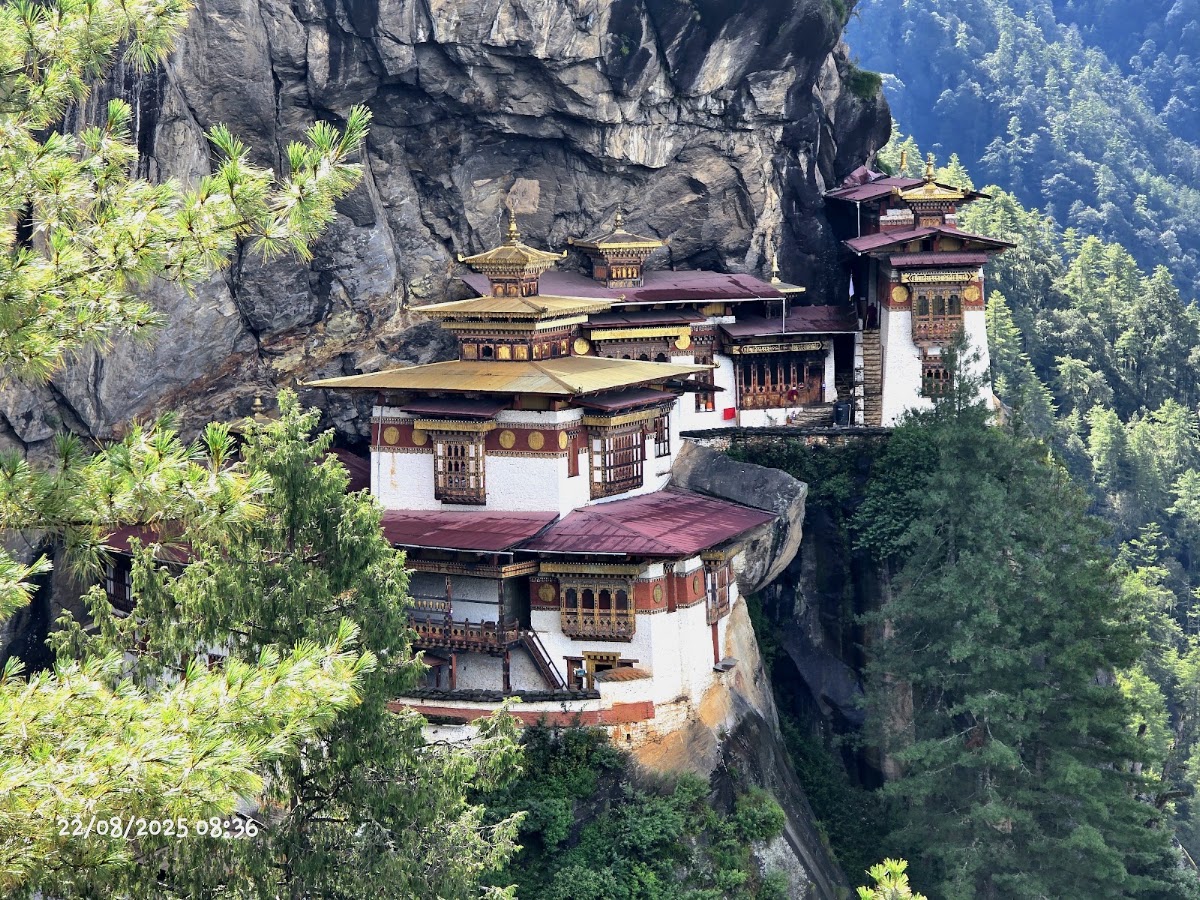
- Tiger's Nest Monastery clinging to a cliff after a three-hour climb
Have this trip planned in 60 seconds
We built the Thimphu, Bhutan itinerary that pairs with this guide, day-by-day with verified venues and one-tap booking links. Free to adopt, edit however you want.
The Drive In From Paro, Where Bhutan Starts Making Sense
Prayer flags strung across the river, the smell of pine and woodsmoke through a cracked car window, and a road that hugs the water the whole way.
You land in Paro (the only international airport in the country, famous for a landing so tight only a handful of pilots are certified to do it) and then you drive. The road to Thimphu runs about 50 km along the Paro Chhu and the Wang Chhu rivers, roughly an hour, and it is your first real look at Bhutan: terraced fields, whitewashed farmhouses with painted window frames, flags fluttering off every ridge.
In Bhutan, independent travel is not a thing. Every visitor books through a licensed operator, pays the Sustainable Development Fee (currently 100 USD per night for most nationalities, confirm the latest figure on the official tourism site), and travels with a guide and driver. So this transfer is already arranged for you. Sit in the back, roll the window down, and let the altitude settle in.
By the time you reach the city your ears have popped twice and the valley has opened up into Thimphu proper, around 2,300 metres above sea level. Drop your bags, drink water, go slow today.
Tashichho Dzong at Golden Hour
White walls catching the last light, gold roof finials sharp against the dark hills, and the low drone of a horn drifting out from inside the courtyard.
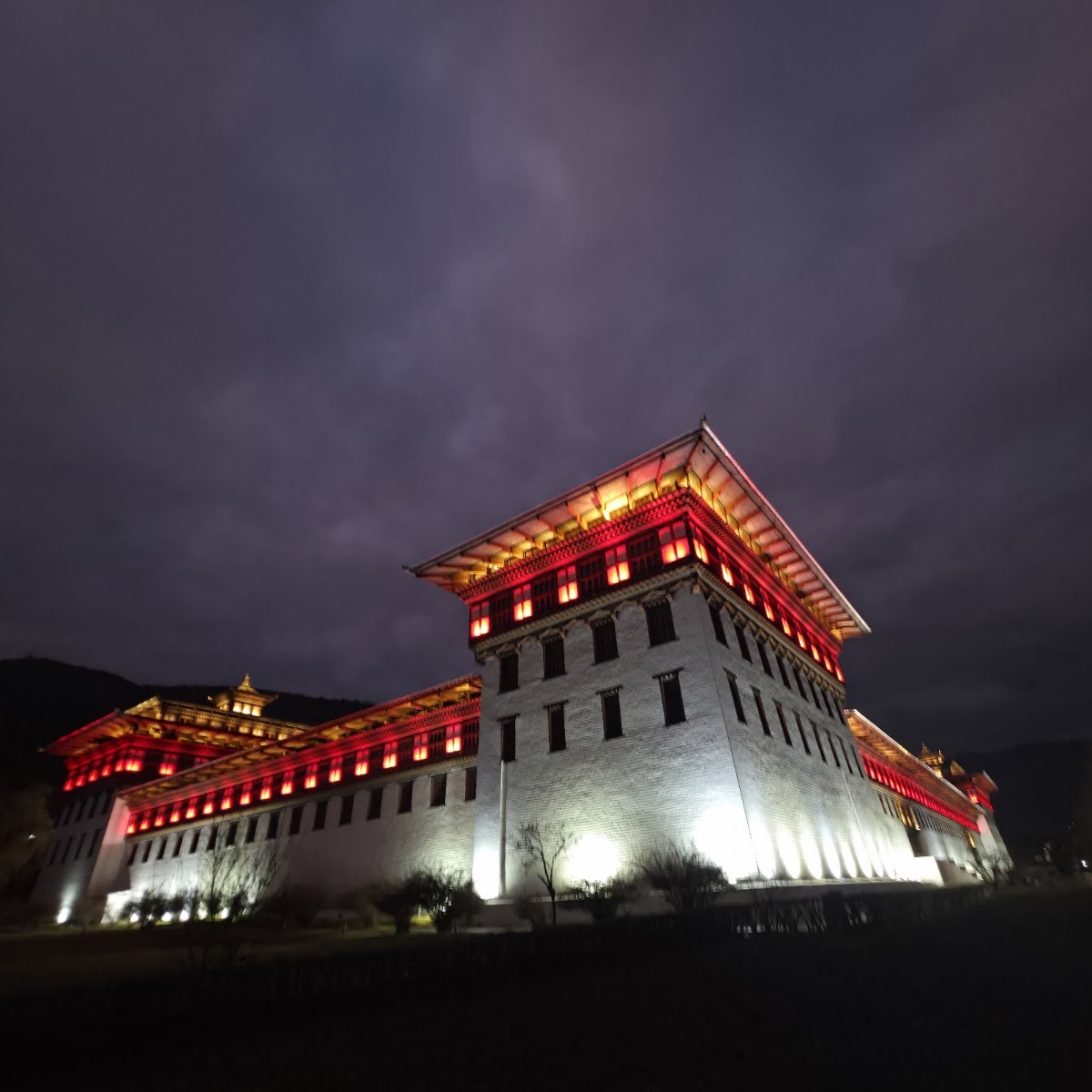
This is the building you picture when you picture Bhutan. Tashichho Dzong is a fortress-monastery on the banks of the Wang Chhu, and it is still a working seat of government: the throne room of the King is here, along with the central monk body during summer. Part religious, part administrative, all beautiful.
Time your visit for late afternoon. The dzong only opens to visitors after office hours on weekdays (roughly 5pm onward, earlier on weekends), which happens to be exactly when the light goes warm and the crowds thin. Your guide handles the timing; you just show up ready to walk the inner courtyard.
Dress code is real here and enforced at religious sites across the country: long trousers or a long skirt, shoulders covered, and shoes off before you enter the temples. Leave the tank top at the hotel.
Buddha Dordenma, 51 Metres of Bronze Over the Valley
A gold Buddha so large you see it from half the city, seated cross-legged on a hilltop with the whole of Thimphu spread out below.
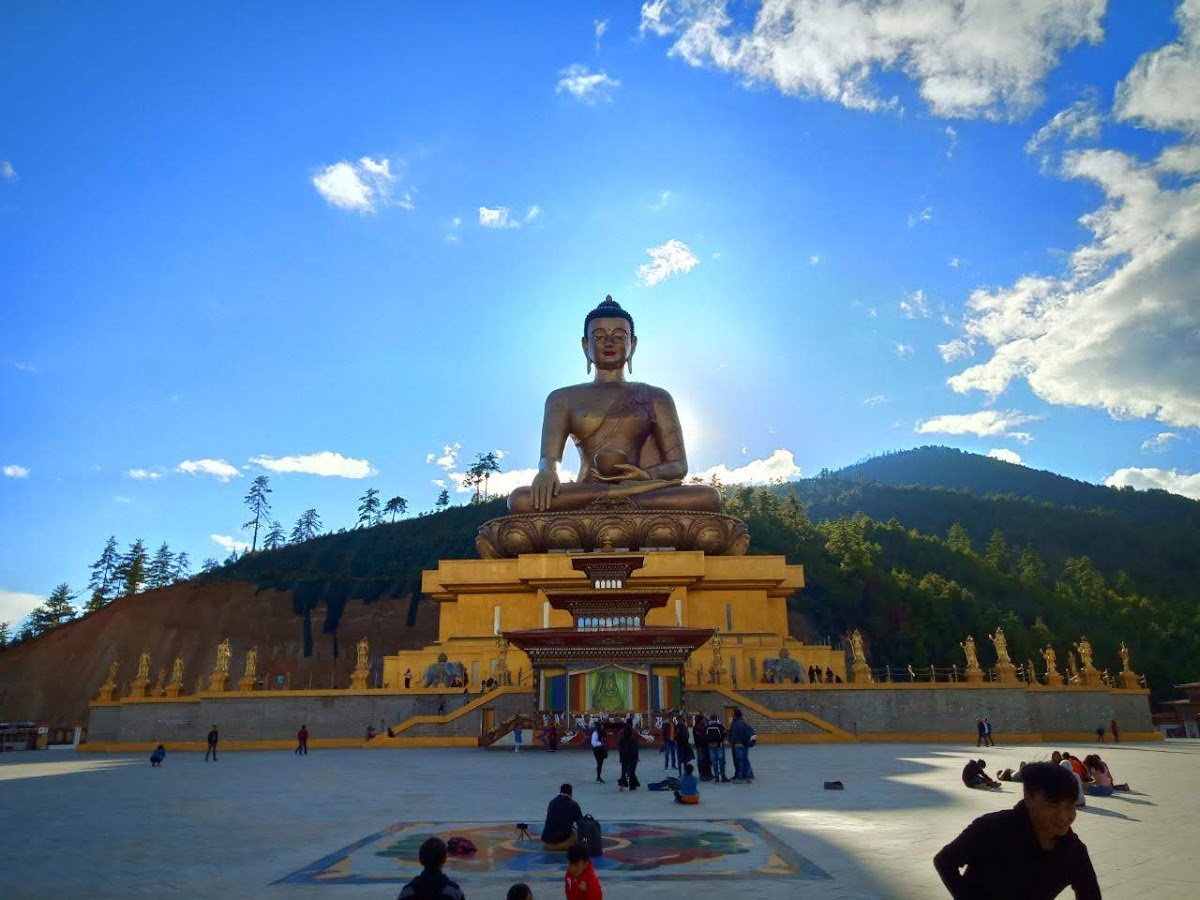
Drive up to Kuensel Phodrang and the scale hits you before you even park. The Buddha Dordenma statue stands 51.5 metres tall, made of bronze and gilded in gold, and houses over one hundred thousand smaller Buddha statues inside its base. It is one of the largest seated Buddhas anywhere.
Go in the morning while the air is clear and the light is coming up over the eastern ridge. The platform around the statue is one of the best panoramic viewpoints over Thimphu, so give yourself time to just stand and look rather than rushing to the next stop.
From here you can pair the morning with the National Memorial Chorten back down in town, a white stupa built in memory of the Third King where locals circle clockwise all day turning the prayer wheels. Watching that slow continuous procession of elderly Bhutanese is its own kind of quiet.
Where the Monks Still Paint by Hand
Rows of students bent over wooden boards, the dry scrape of brush on canvas, and gold leaf catching the light where a thangka is slowly coming to life.
The National Institute of Zorig Chusum, known as the painting school, teaches the thirteen traditional arts and crafts of Bhutan. You walk through workshops where young students learn thangka painting, wood carving, embroidery, and clay sculpture, each discipline in its own bright room.
It is not a staged performance. These are real multi-year apprenticeships, and you are a guest passing through, so keep your voice down and ask your guide before photographing anyone up close.
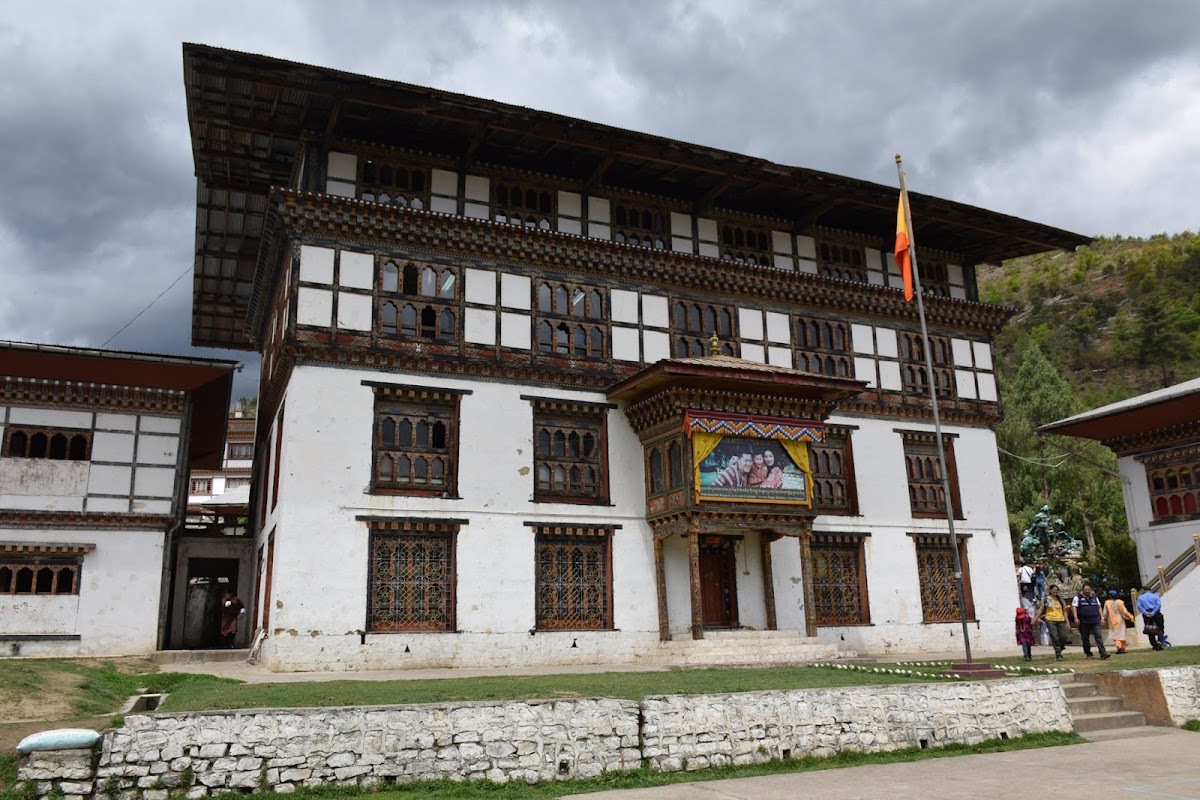
Pair it with the Folk Heritage Museum a short drive away, a restored three-storey rammed-earth farmhouse set up exactly as a rural Bhutanese family would have lived a century ago. The kitchen smells faintly of smoke, the floors creak, and suddenly all that whitewashed architecture you have been photographing makes human sense.
Takin, the National Animal You've Never Heard Of
A creature that looks like someone bolted a moose head onto a small bear, chewing calmly behind the fence in a forested hillside enclosure.
The Motithang Takin Preserve exists because of a legend: the takin is said to have been created by a mad saint who stuck a goat's head on a cow's bones and brought it to life. It is now the national animal of Bhutan, and this preserve on a wooded slope above Thimphu is the easiest place on earth to actually see one.
The animals roam a large forested enclosure, so bring patience and look toward the trees. Early or late in the day you have the best odds of catching them grazing near the viewing path.
While you are up on this side of town, the Dechen Phodrang Monastery sits nearby, a monastic school where young novice monks study. Climb up and you will often hear them chanting their lessons, a sound that carries down the hill like the whole building is humming.
The Climb to Tiger's Nest
A monastery glued to a sheer cliff 900 metres above the valley floor, appearing and disappearing through the drifting cloud as you climb toward it.
Drive back toward Paro and point yourself at the thing everyone comes to Bhutan for. Paro Taktsang, the Tiger's Nest, clings to a granite cliff at around 3,120 metres, built where Guru Rinpoche is said to have meditated after flying in on the back of a tigress.
The hike up takes roughly two to three hours one way, climbing steeply through blue pine forest before the trail cuts across the cliff face to the monastery itself. There is a cafeteria roughly halfway with a killer viewpoint if you need to catch your breath, and ponies can carry you part of the way up (not down). Start early, carry water, and take the altitude seriously; this is the hardest physical thing most visitors do all trip.
Inside, phones and cameras must be left in lockers, so you experience the shrines with your own eyes and nothing between. Honestly, that is the point.
Rinpung Dzong and a Slow Afternoon in Paro Town
A wooden cantilever bridge over the river, a whitewashed fortress rising behind it, and the main street of Paro lined with painted shopfronts and the smell of butter tea.
After the climb, Rinpung Dzong is the gentle reward. You cross the traditional covered Nyamai Zam bridge to reach it, and the fortress itself is a masterclass in Bhutanese dzong architecture: steep whitewashed walls, intricate woodwork, and a central tower. If you timed your trip for spring you might catch the Paro Tshechu, one of the country's great festival dances, held in its courtyard.
Then wander Paro town. It is small, walkable, and far mellower than Thimphu, a single main street of shops where you can pick up handwoven textiles, prayer flags, and a bowl of ema datshi (the national dish of chillies and cheese that will absolutely test your heat tolerance).
Settle into a Paro valley hotel for the night; waking up here with the fields outside your window is a softer last morning than staying back in the capital.
One Last Temple Before the Airport
A low ancient temple with an orange tree in the courtyard, floorboards worn smooth by centuries of feet, and the faint smell of juniper incense on the morning air.
Save Kyichu Lhakhang for your final morning. It is one of the oldest temples in Bhutan, said to date to the 7th century, one of 108 temples a Tibetan king built in a single day to pin down a demoness lying across the Himalayas. It is modest, dim, and deeply atmospheric, the opposite of the grand dzongs.
Stand in the courtyard, look at the orange tree that reputedly fruits year-round, and let the trip land. This is the kind of place you leave quieter than you arrived.
Then it is a short transfer back to Paro airport, and that white-knuckle takeoff between the mountains you were too nervous to appreciate on the way in. This time you will know to watch.
Ready to book?
Book the rest of Thimphu, Bhutan
Handpicked partner searches, dates pre-filled. Pricing is identical to going direct — the partner shares a small commission with Tabi so this guide stays free.
Frequently asked
Do I need a guide and a visa to visit Thimphu?
Yes. Bhutan requires most foreign visitors (except Indian nationals, who have separate rules) to book through a licensed tour operator, obtain a visa in advance, and travel with a guide and driver. You also pay a Sustainable Development Fee per night. Confirm the current fee and application steps on Bhutan's official tourism website, as the amounts have changed in recent years.
How hard is the hike to Tiger's Nest?
It is a genuine uphill trek: roughly two to three hours each way, climbing to about 3,120 metres on a steep forest trail. If you have reasonable fitness and take it slowly it is very doable, and there is a halfway cafeteria to rest. The altitude is the real challenge, so hydrate well and ideally spend a couple of days acclimatising in Thimphu first. Ponies can carry you up part of the way but not down.
How many days do I need for Thimphu and Paro?
Five days is a comfortable amount: two to three in Thimphu for the dzong, Buddha Dordenma, the museums and the takin preserve, then two in Paro for Tiger's Nest, Rinpung Dzong and Kyichu Lhakhang. You can compress it into three or four, but altitude and the slow pace of the country reward a little breathing room.
What is the best time of year to go?
Spring (March to May) and autumn (September to November) are the sweet spots, with clear mountain views, mild days and the big tshechu festivals. Autumn in particular gives you crisp skies for the Tiger's Nest climb. Summer brings monsoon rain and cloud that can hide the peaks, while winter is cold and clear but some high passes may be snowed in.
What should I eat and will it be too spicy?
The national dish is ema datshi, chillies cooked with local cheese, and Bhutanese food treats chillies as a vegetable rather than a seasoning, so yes, it runs hot. Ask for milder versions and balance it with red rice, momos (dumplings), and butter tea. Your hotels and the restaurants your guide picks will happily tone down the heat if you ask.
Skip the planning
Your Thimphu, Bhutan trip, ready to go
Adopt the day-by-day itinerary we built to match this guide. Every stop is a real place, every booking link is validated. Free forever, no card needed.
Open the Thimphu, Bhutan itinerary